adsense

lunes, 10 de agosto de 2015

FESTIVAL DE SILLETEROS DE MEDELLIN / COLOMBIA.


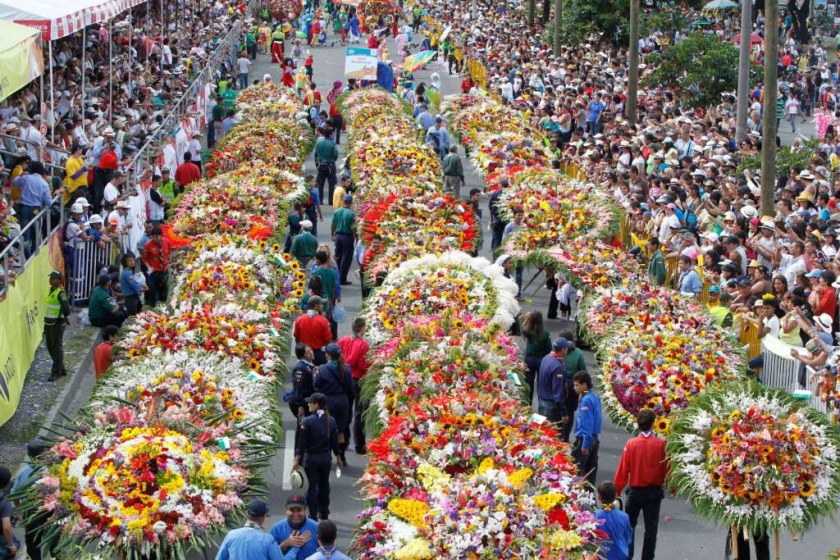
La edición número 58 del acostumbrado Desfile de Silleteros en Medellín (Antioquia), mantendrá este año su acostumbrada ruta, la cual corría el riesgo de ser cambiada por el trabajo de obras que se llevan a cabo en la ciudad.

La Corporación de Silleteros de Santa Elena (corregimiento de Medellín), de Colombia, celebró este martes la confirmación de que este 2015 mantendrán la ruta que han venido realizando en los últimos años en el Desfile de Silleteros en Medellín (Antioquia).

Se trata de una famosa marcha de flores en silletas, patrimonio cultural de Colombia, que tendrá como sede en agosto próximo el poblado de Santa Elena, cuyos cultivadores acondicionan plantíos y canastas para el esperado espectáculo.

El asentamiento, situado a 12 kilómetros de la ciudad de Medellín, es reconocido internacionalmente por su gran feria, en la cual unos 500 lugareños exhiben en estrechas calles y plazas atractivos arreglos con plantas florecidas.

La confirmación de la ruta fue dada a conocer por el presidente de la corporación, Óscar Atehortúa Ríos, quien expresó que en las reuniones organizativas efectuadas hasta el momento con la Alcaldía no se habían hecho cambios en el recorrido, pese a que se ejecutan obras en el tramo donde se realiza el desfile, entre el puente de Guayaquil y San Juan.
 “Hasta ahora se mantiene. Es un recorrido ideal y plano”, sostuvo Atehortúa, quien indicó que la procesión de este año, que llega a su edición número 58, se realizará el próximo 9 de agosto. Una de las nuevas sorpresas es que los cerca de 500 silleteros tendrán un nuevo atuendo típico.


El Desfile de Silleteros es una tradición que data de 1957, cuando hombres y mujeres de la zona decidieron mostrar públicamente la diversidad de flores del lugar y el fruto del trabajo esmerado de los cultivadores, pues hasta el momento solo se usaba para adornar los altares de las iglesias o las viviendas.

Colombia es uno de los principales exportadores de flores en el mundo, con ventas anuales por más de 1.000 millones de dólares.
El principal mercado de las flores colombianas es Estados Unidos (76%), seguido de Rusia (5%), Japón (3%), Reino Unido (3%) y Canadá (2%), de acuerdo con la privada Asociación Colombiana de Exportadores de Flores(Asocolflores).


The 58th edition of the usual parade Silleteros in Medellin (Antioquia), continue this year his usual route, which ran the risk of being changed by the work of works being carried out in the city.
Silleteros Corporation of Santa Elena (district of Medellin), of Colombia, held on Tuesday confirmed that this remain the route 2015 they have been making in recent years in the Parade of Silleteros in Medellin (Antioquia).

It is a famous march of flowers in saddles, cultural heritage of Colombia, which will be held next August the town of Santa Elena, whose growers conditioned plantations and baskets for anticipated show.

The settlement, located 12 kilometers from the city of Medellin, is internationally recognized for its great fair, where about 500 villagers exhibited in narrow streets and squares attractive arrangements with flowering plants.


Confirmation of the route was announced by the president of the corporation, Oscar Atehortúa Rios, who said that in organizational meetings held so far with the Mayor had not made changes to the route, although works are executed in the section where the parade takes place, between the bridge of Guayaquil and San Juan.
 "So far it remains. Is an ideal and flat course, "said Atehortúa, who said the procession this year, which reaches its 58th edition, will take place on August 9. One of the new surprises is that the 500 silleteros have a new typical attire.

The Silleteros Parade is a tradition that dates from 1957, when men and women of the area decided to publicly show the diversity of local flowers and fruit of the painstaking work of growers, because until now only used to adorn altars churches or homes.
Colombia is one of the major exporters of flowers in the world, with annual sales of more than 1,000 million.


The main market for Colombian flowers is the United States (76%), followed by Russia (5%), Japan (3%), UK (3%) and Canada (2%), according to the Colombian Association of Private Flower Exporters (ASOCOLFLORES).


Mariano Lorenzo Melgar Valdivieso


Mariano Lorenzo Melgar Valdivieso; Arequipa, 1790 - Umachiri, 1815) Poeta peruano. Considerado como uno de los fundadores de la literatura peruana contemporánea, es autor de poemas amorosos de imitación indígena (yaravíes), precedente del nativismo romántico.

De gran precocidad intelectual, cursó filosofía y teología y recibió las órdenes religiosas menores en 1810; pero abandonó la carrera eclesiástica al enamorarse de una dama, María Santos Corrales, la que aparece en sus poemas con el nombre de Silvia. Enseñó latín, retórica, filosofía, física y matemáticas. En 1812 viajó a Lima para estudiar derecho en los claustros de San Carlos, coincidiendo su estancia en la capital con las manifestaciones en favor de la Independencia.

Melgar retornó a Arequipa en 1814; entretanto, su amada Silvia cedió a la oposición de sus padres y rechazó al poeta; el dolor afectó gravemente su salud. Probablemente a ello se debió la excelente traducción de los Remedia amoris de Ovidio, que dejó inédita, y desde luego, la composición Carta a Silvia. Melgar se incorporó poco después a la rebelión emancipadora de Mateo Pumacahua, a quien sirvió como auditor de guerra; tras la batalla de Umachiri fue apresado y sometido a consejo de guerra; el 12 de marzo de 1815 fue fusilado. Póstumamente, en 1878, se editó el volumen Poesías de don Mariano Melgar.


A pesar de su formación neoclásica, la obra de Melgar presenta rasgos prerrománticos: sentimentalismo, amor por la naturaleza, culto a la libertad y fervor patriótico. También resulta prerromántico su interés por las inquietudes del pueblo y su asimilación de una forma mestiza de canción muy extendida en los Andes, el yaraví, en que el idioma es el español pero la música y la temática resultan andinas. Los yaravíes de Melgar significaron el triunfo de esa veta popular entre las capas urbanas y cultas, especialmente en Arequipa, donde un yaraví melgariano es considerado como una especie de himno de la "patria chica".

Los yaravíes son composiciones en metros cortos cuyo tema más común es el lamento amoroso; se cantan con acompañamiento de guitarra o de "quena" (flauta de caña de los indios peruanos). Desde el punto de vista estrictamente literario, los "yaravíes" de Melgar son algo ingenuos, y su versificación es a menudo defectuosa, pero alcanzan un singular dramatismo con la música y con los acentos doloridos de los cantores. Constituyen además una manifestación sumamente interesante del mestizaje cultural en América.


En la forma del yaraví hay, desde luego, huellas de la poesía española de la época (particularmente de Meléndez Valdés). Pero, en el espíritu y en el nombre mismo, el yaraví proviene de los harauis de los incas, canciones líricas de amor o de asuntos campestres, tristes o alegres, y acompañadas por la flauta. Documentados por los cronistas, en los siglos XVI y XVII se los menciona como cantos indígenas y populares, sin precisar bien su carácter. Pero en el siglo XVIII, con la iniciación de la conciencia nacional y los anuncios del Romanticismo, alcanzan nuevo impulso, sobre todo en el sur del Perú, y ya con el carácter específico de poesía triste, de lamentación y soledad.


Compuestos originalmente en lengua quechua, se escribieron luego en español; rural en sus comienzos, el yaraví pasó a la ciudad, y la "quena" se unió o se reemplazó con la guitarra. El centro de esa transformación criolla fue Arequipa, y Melgar el poeta más excelente y de más fuerza dramática. En la edición póstuma de las Poesías de don Mariano Melgar (1878) aparecen sólo diez yaravíes, pero se le atribuyen muchos más, porque su nombre se ha convertido en un símbolo del género. Su poder de atracción es aún tan grande que sus yaravíes siguen cantándose y llorándose noche tras noche en Arequipa.

Aparte de los yaravíes, en las inclinaciones líricas de Mariano Melgar se aprecian diversas facetas: la de poeta erótico, influido principalmente por las anacreónticas que había leído; la de autor de odas, entre las que son dignas de especial mención las dedicadas a la libertad y al mar, con algunas elegías, y la de fabulista, aspecto éste muy singular en las letras peruanas. Cinco son solamente las fábulas que escribió (el cantero y el asno, las abejas, las cotorras en un maizal, los gallos y los pavos y el asno cornudo). Su formación clásica adquirida en sus tiempos del seminario, que no dejó de influirle a lo largo de su breve carrera lírica, lo llevó a traducir composiciones de Ovidio y Virgilio. En su traducción de Remedia amoris de Ovidio modificó ingeniosamente su título por el de Arte de olvidar.


Mariano Lorenzo Melgar Valdivieso was born in Arequipa, Peru, 10 of August of 1790 . died in Fist 12 of March of 1815 . For many Romanticism is the initiator of in this part of the world. In him the romanticism is not imitation than or became in the Iberian Peninsula or France, but a deep and own feeling, we do not forget that she was a young person and precocious poet who did not reach to mature because she surprised to the death looking for it the free mother country. Mariano Melgar expresses racially mixed an Andean feeling/, that nobody was had bold to expose until that then ones in a so prejudiced and hispanicized society that it worsened by the Limean centralism. Sight from this angle, Melgar is the initiator of the truly Peruvian poetry, without going to the European styles to try that they consider poet. participated in the war by the independence of Peru against Spain. Melgar is one of first romantic of Peru in Century XIX, more known to include in its creation the feeling of Yaravíes 'indigenous (sentimental songs mainly of the Andean South zone).


Mariano Melgar was gift son Don Juan de God Melgar Sanabria and Do6na Galician Andrea Valdivieso. was baptized two days after its birth in Cathedral of Arequipa . It grew in its native earth, to the three years already it knew to read and to write. His brother Jose Fabio Melgar affirmed that to the eight years already he handled the Latin, and other authors indicate that in addition Melgar before turning the ten years got to dominate English and the French. He studies early in the Convent of San Francisco. Before the eight years informed and worthy Chavez bishop of the Rose conferred the prime tonsura to him and he dressed the clerical habit to him. This meant in the long run a litigation that would finish when fulfilling Melgar its 23 years, consisted of the obtaining of a chaplaincy in a vine in the valley of Majes.

 One is due to mention that he was the father of the poet who was interested in that Mariano obtained this chaplaincy, and that their plans were affected before the decision of the Melgar young person to leave the habits. It is during this stage of his life that Melgar had had access to one nourished library, the library of the Council Seminary of San Jerónimo, that at that time had reached reputation under the direction of Pedro bishop Jose Chavez of the Rose that always had as well shown to special interest in the new concepts and brought theories of the old world; for that reason the library of the Seminary and San Jerónimo was well-known like one of most complete of the city (if not more complete it), besides owning between its volumes many of which they were prohibited in the virreynato by his revolutionary character (it knows that many of the most outstanding personages of the first Republican years formed in this Seminary and had access to these books).

 He was masterful of Latinidad and Retórica, Philosophy and later figure also like professor of Physics and Matematica. It is shortly after to have received you order minors in the Seminary San Jerónimo and by " Melissa" (whose true name was Manuelita Walls) that Melgar decides to leave the habits having twenty years. It is led towards Literature where emphasizes his Poetry . After his first deception (that is made notice in his " Soneto to the Mujer") Maria Holy Corrals, better fell in love with well-known like Silvia, to that he would romantically mention in his famous yaravíes (he forms poetic lyrical cradle in the feeling in which the great singer arequipeño expresses its bitterness and its sadness). All their loving drama and biography can be considered likely being taken from its well-known " Letter to Silvia", in that the express poet in 522 verses how he knew the love and the pain, until the appearance and loss of young loved his. Outside the loving subject, Melgar also had begun to show interest in the political subjects, is thus, that impelled by its ideals, Mariano persuades its parents to go to study laws to Lima . The desire of independence in Lima was as high as the fields of History, Geography, Mathematical Philosophy and . 


Time later, decided to return to Arequipa, to only find Silvia, that had been persuaded by its father to leave any idea to be united with Melgar (says to the tradition and legend of Melgar that this opposition had to that the Holy family of Maria Corrals blamed to the poet by the death of the mother of the Young person " Silvia"). Although it turned it to the legend into the eternal lover of " Silvia", those are in fact as much their love as their patriotic feeling that impelled of complementary way (" to him; By Silvia master Mother country with care, and by my mother country loved Silvia quiero"). It is after the rejection undergone on the part of Maria Holy Corrals, that Melgar decides mudar to the valley of Majes. And in November of 1814 that Melgar decides to enlist itself in the army of Pumacahua and travels towards Chuquibamba leaving its retirement in Majes, being united to a column of patriotic that would leave later to the city of Arequipa. After an intense fight, Melgar dies streamlining having 24 year and a half, in Umachiri, the 12 of March of 1815.

Melgar in its loving sadness, goes away to Majes (to the west of Arequipa). Possibly, it makes contact with the enemy with other independentistas revolutionaries of the time. In 1814, the revolution of Mateo Pumacahua took place in Cusco, which infuriated the apparent tranquility of virreinato Spanish in Peru and urged Melgar to be united to the independentista cause. After gaining Combate de Apacheta in Arequipa, the army marched towards Fist in Batalla de Umachiri . After the defeat of the independentistas troops these were made prisoners, including the Melgar young person. Spanish general Ramirez, after maintaining captive to Melgar by a time, ordered his officials to shoot it. Melgar died in the morning of 12 of March of 1815, shortly before fulfilling the age of twenty-five years.

In message before its death, Melgar wrote to the Spanish officials: " They cover its eyes, since you are the one who will need mercy because America will be free in less than ten years! " . Nine years later, 9 of December of 1824, Batalla of Ayacucho would take place in Pampas from the Quinua, to few kilometers of distance of Ayacucho, close to the town of Quinua . This battle - between realists (Spanish) and nationalists (republican) - sealed to the independence of Peru and South America before Spain.

2 of July of 1964, in recognition by its bravery in the first predecesoras battles to independence, the government of Peru recognized Mariano Melgar like the one of the first patriotic and soldiers of the country for the revolution by officially Independence of Peru .
Poetry

Melgar, as poet and with Jose jointly Holy Chocano and Caesar Vallejo reaches to conform, which in many publications, the understood ones considers - talvez unifying the three works of bards for being of the same country like a true poetic trilogy Peruvian immortal. sonetos, Yaravíes and Metric of Melgar world-wide have been recognized; then in many occasions, their poems have been selected and comprise of many poetic anthologies printed as much as outside their native country inside, inclusively having translated in much languages, since also it has been the case of works of his companions of this mentioned classic " literary Triangle ".
Melgar and its fables

Very little it has been written and studied about this special melgariana production, nevertheless the Ataucuri brothers Garci'a emphasize in estracto of their book dedicated to this subject: " Melgar thought firmly that Literature was a useful tool to change to the society; for that reason it wrote his fables, small jewels where the writer with the patriotic one is amalgamated perfectly.

The thematic one of their fables, very opportune for the so crucial historical moment that it was lived in that stage, reaffirms their commitment with the independentista cause. In addition, they have the unusual characteristic of to be written for a very specific conjuncture: the stage of the emancipation, with its social conflicts, ideological confrontations, political, moral, governmental anarchy, etc.; particularitity that is rare in classic fables where the atemporalidad of the subjects stands out.


In 1813, the newspaper the Investigator of Lima, publishes the fable " the ruiseñor and the caleche driver " where Melgar criticism the subordination of the tastes from the town to the foreign whims of people owner of the political and economic power. This would be the unique fable that Melgar sees published, because the other come to the light several years after their death.

Later, in 1827, is the newspaper the Republican of Arequipa that is in charge to present other fables more. In successive form " publishes seven; fables políticas" according to writing note in which one heightens the qualities of the ill-fated Melgar countryman. " the bat " and " the cats " the 16 of June of 1827 are printed; " the stonecutter and the ass " and " the bees " 23 and 30 of the same month; " the cornudo ass ", the 7 of 1827 July. Later, the 27 of November of 1830, publish " you cotoast and the fox ", concluding with " the domestic birds ", the 6 of August of 1831.

Years later, specifically the 13 of November of 1891, the newspaper arequipeño Stock-market publishes, taking like source the manuscripts from Martin Ureta, the fables " the Sun " and " the ruiseñor and the caleche driver ", that already had been published in 1813. The last fable that has managed to know itself is " the whale and the wolf ", open pie within an original manuscript of Mariano Melgar and that is kept in the Library of Lilly of the University of Indiana, institution acquired that it next to legajo of historical documents of Latin America. In this way, the melgarianas fables are ten altogether, although others add " the blind person, the deaf person and dumb ", but by their thematic and style still doubts exist that are of Melgar".


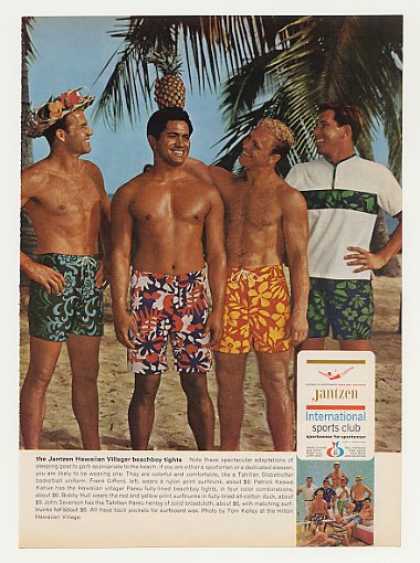
Frank Gifford


Frank Gifford starred for the New York Giants during his Hall of Fame NFL career before becoming a successful broadcaster.

Born on August 16, 1930, in Santa Monica, California, Frank Gifford attended USC on a football scholarship. He played for the NFL's New York Giants for 12 years, winning MVP honors after leading the team to the championship in 1956. Following his NFL career, Gifford became a mainstay in the broadcast booth for Monday Night Football. He died on August 9, 2015, at age 84.

American football player and sports broadcaster Frank Gifford was born on August 16, 1930, in Santa Monica, California. The recipient of a full-tuition scholarship from the University of Southern California, he was selected by the NFL's New York Giants with the 11th overall pick of the 1952 draft.


Used at running back, defensive back and wide receiver, Gifford became the team's signature player for more than a decade. He was named to the Pro Bowl in every season from 1953-59, and voted the league MVP in 1956 after helping the Giants win the NFL title.


Gifford missed the entire 1961 season after suffering a concussion, but he returned in 1962 and earned his final Pro Bowl selection the following year. He retired after the 1964 season with 5,434 career receiving yards, which remained the team record until it was surpassed by Amani Toomer in 2003.


Even while an active player, Gifford worked as a sports broadcaster on radio and television, first on CBS, then ABC. From 1971 he became a regular on ABC-TV, with Monday Night Football and Wide World of Sports, as well as occasional specials. In 1977, he was elected to the Pro Football Hall of Fame and was honored with an Emmy for Outstanding Sports Personality. He left Monday Night Football for good in 1998.
In addition to his broadcast work, the handsome athlete starred in the 1959 film Up Periscope, and appeared in such television shows as Captain Kangaroo and The Six Million Dollar Man. He also wrote or co-authored several books on football.
Frank Gifford married popular talk show host and singer Kathie Lee Epstein Johnson on October 18, 1986. The couple had two children, son Cody (b. 1990) and daughter Cassidy (b. 1993). Gifford also had three children with his first wife, Maxine Avis Ewart: Jeff, Kyle and Victoria.

Gifford died on August 9, 2015, just shy of his 85th birthday, at his home in Connecticut.


Gifford nació en Santa Monica, California. Después de graduarse de la escuela Bakersfield High School, Gifford no pudo ganar una beca atlética para poder estudiar en la Universidad del Sur de California (USC) debido a sus bajas calificaciones. Jugó un año en el Bakersfield College, llegando a ser seleccionado como Junior College All-American mientras lograba las calificaciones necesarias para enrolarse en USC.2 En USC, Gifford fue nombrado como All-America.
Comenzó su carrera en la NFL con los New York Giants jugando tanto a la ofensiva como a la defensiva, una rareza después de la Segunda Guerra Mundial. Llegó a ocho Pro Bowls y participó en cinco Partidos de Campeonato de la NFL, el antecesor del Super Bowl. la mejor temporada de Gifford tal vez fue la de 1956, cuando ganó el premio del MVP de la NFL, liderando a los Giants al título de la NFL sobre los Chicago Bears.


Perdió 18 meses en la parte más alta de su carrera cuando fue víctima de uno de los golpes mas brutales (aunque completamente legal en su época) en la historia de la NFL. Durante un partido de la temporada de 1960 en contra de los Philadelphia Eagles fue tackeado en su "lado ciego" por Chuck Bednarik en una jugada de pase, sufriendo una seria lesión en el cráneo que casi lo obligó a retirarse. Pero Gifford regresó a jugar con los Giants en 1962, cambiando su posición de running back a wide receiver (posición entonces conocida como flanker). A pesar de su forzoso descanso y tener que aprender una posición completamente nueva, volvió a brillar en la NFL.


Sus selecciones al Pro Bowl fueron en tres posiciones diferentes, defensive back, running back, y wide receiver. Se retiró finalmente en 1964, después de llegar a su último Pro Bowl como receptor.


Durante sus 12 temporadas con los New York Giants (136 partidos de temporada regular) Gifford acumuló 3,609 yardas por tierra con 34 touchdowns en 840 acarreos, y consiguió atrapar 367 pases para 5,434 yardas y 43 touchdowns. Gifford completó 29 de 63 pases lanzados para 823 yardas y 14 touchdowns.

Gifford fue electo al Salón de la Fama del Fútbol Americano Universitario en 1975 y al Salón de la Fama del Fútbol Americano Profesional el 30 de julio de 1977.


Bernard "Bernie" Sanders


Bernard "Bernie" Sanders (nacido el 8 de septiembre 1941) es un político de Estados Unidos, presente senador de Vermont. Ha anunciado su candidatura a la nominación demócrata en las elecciones presidenciales de 2016. Sanders es el senador independiente con mayor tiempo dentro del Congreso Americano en la historia de Estados Unidos.

Se describe a sí mismo como un social demócrata, que está a favor de políticas similares a las de los partidos social demócratas en Europa, en particular los de los países escandinavos por los altos estándares de vida para la clase media y baja de estos países. Protección al medio ambiente, el derecho a la educación, el derecho a salud pública, y valores de familias dentro de las uniones de trabajadores son ejemplos de las políticas que Sanders promueve. Ejerce su caucus con el Partido Demócrata y es miembro de la minoría de mayor rango en el Comité de Presupuesto del Senado desde enero de 2015.


Después de candidaturas sin éxito para ser gobernador de Vermont y senador entre principios y mediados de los setenta, Sanders fue elegido alcalde de Burlington, la ciudad más poblada de Vermont, en 1981. Fue reelegido para otros tres períodos de dos años en la alcaldía antes de ser elegido para representar a Vermont para el gran Congreso de los Estados Unidos Cámara de Representantes en 1990. Se desempeñó como miembro del Congreso durante 16 años antes de ser elegido para reemplazar a Jim Jeffords. Sanders se convierte en senador el año 2006. Luego, fue reelegido en el 2012 por un amplio margen, la captura de casi el 71% del voto popular.


Desde su elección al Senado, Sanders ha surgido como una voz progresista líder en temas como la desigualdad de ingresos, el cambio climático, y la reforma de la financiación de campaña. Él se levantó a la prominencia nacional en los talones de su obstruccionismo 2010 de la propuesta de ampliación de las tasas de impuestos de la era Bush para los ricos. Sanders también es defiende abiertamente los temas de libertades civiles, y ha sido particularmente crítico de las políticas de vigilancia de masas, como la Ley Patriota, ley que causado escándalos por su violación a los derechos de privacidad de los ciudadanos Americanos a través de la NSA “Asociación de Seguridad Nacional”.


Sanders anunció sus intenciones de buscar la nominación del Partido Demócrata a la presidencia el 30 de abril de 2015, en un discurso en el césped del Capitolio. Su campaña se lanzó oficialmente el 26 de mayo en Burlington: “Suficiente, es suficiente. El gobierno de los Estados Unidos de América le corresponde a todos los estadounidenses, y no a un grupo de billonarios.”
Senator Bernie Sanders is America's longest-serving independent politician in Congress and a candidate for president in 2016.


Born in 1941, politician Bernie Sanders started out his career as the mayor of Burlington, Vermont. He served four terms as the leader of Vermont's biggest city from 1981 to 1989. Sanders then moved on to the national political arena by winning a seat in the House of Representatives. From 1991 to 2007, he distinguished himself as one of the country's few independent legislators. In 2007, Sanders won election to the U.S. Senate and was reelected in 2012. He announced his plans to run for the Democratic presidential nomination in 2015.

In April 2015, Sanders announced that he was seeking the presidential nomination for the Democratic Party. This longtime independent made the party switch largely out of political necessity. "It would require an enormous amount of time, energy and money just to get on the ballot in 50 states" as an independent, he said to USA Today. "It made a lot more sense for me to work within the Democratic primary system where it's much easier to get on the ballot and have a chance to debate the other candidates."


Experts think it is unlikely that Sanders will be able to wrestle the Democratic nomination away from front-runner Hillary Clinton. But, according to an Associated Press report, Sanders isn't worried about being an underdog in the race for the Democratic presidential nomination. "People should not underestimate me." As a veteran independent, he has "run outside of the two-party system, defeating Democrats and Republicans, taking on big-money candidates."

Staying true to his ideological convictions, Sanders's platform focuses on issues of equality in the United States. Economically, he favors tax reform that increases rates for the wealthy, greater governmental oversight of Wall Street and balancing the disparity between wages for men and women. He also believes in a state-administered health care system, more-affordable higher education and an expansion of the Social Security, Medicare and Medicaid systems. A social liberal, he also supports same-sex marriage and is pro-choice.


SNOOPY CUMPLE 65 AÑOS.


Snoopy cumple 65 años:
Tal día como hoy, hace 65 años, nacía en la ficción el perro Beagle más icónico. Snoopy cumple 65 años y lo hace pendiente de debutar en la gran pantalla con una imagen muy diferente a aquella con la que vio la luz en las tiras cómicas. Lejos de acusar los años, Snoopy regresará renovado en animación en 3D y dispuesto, como siempre, a ayudar a Carlitos en sus aventuras.     Si bien Snoopy apareció por primera vez en los cómics el 4 de octubre de 1950, dos días después después de la primera publicación de la tira de Charles Schulz, su nacimiento ficticio no corresponde a este día.     El famoso perro nació un 10 de agosto, tal y como nos desvelaron Carlitos y Lucy. Los dos niños y sus amigos sorprendieron a Snoopy con una tarta de cumpleaños el 10 de agosto de 1968. Así, muchas décadas después, este lunes Snoopy cumple 65 años humanos y 455 perrunos.


En este día tan especial una de las primeras en felicitar a Snoopy ha sido Meghan Trainor. La superestrella mundial candidata al Grammy y ganadora de varios discos de platino no solo ha prestado su voz para el tema principal de Carlitos y Snoopy la película de peanuts.  


  Trainor también ha tirado de cuerdas vocales para entonar el 'Happy Birthday Dear Snoopy', un vídeo que ha compartido a través de las redes sociales.
Asimismo, el director de la cinta Steve Martino ha querido celebrar este día con un clip en el que enseña y anima a todos los seguidores de Snoopy a dibujarlo y compartirlo con el hashtag #FelicidadesSnoopy.


Snoopy cumple 65 años: De la tira cómica al cine en 3D
DEBUTARÁ EN LA GRAN PANTALLA    Mucho ha cambiado el adorable perrito en sus 65 años de existencia. Al principio Snoopy tenía muchas más similitudes con los perros reales (andaba sobre cuatro patas y no se mostraban sus pensamientos) pero con el paso de los años fue adquiriendo características cada vez más humanas.


La última versión de Snoopy es en una sensacional animación en 3D de última generación en 'Carlitos y Snoopy y la película de Peanuts'. Una cinta que llegará cuando se conmemora no solo el cumpleaños de la mascota de Carlitos, sino también el 65º aniversario del estreno de la tira cómica de Charles Schulz ('Peanuts') y los 50 años de 'A Charlie Brown Christmas', verdadero hito de los programas especiales de televisión.


En la nueva cinta de 20th Century Fox Carlitos, el desvalido más querido del mundo, se embarca en un viaje épico y heroico mientras que su amigo del alma, el adorable sabueso Snoopy, se eleva a los cielos para enfrentarse a su archienemigo, el Barón Rojo.    Carlitos y Snoopy la película de Peanuts llegará a nuestras salas el 25 de diciembre. Por su parte, la banda sonora de Carlitos y Snoopy la película de Peanuts saldrá a la venta en todo el mundo el 23 de octubre de 2015 en EPIC Records.


lunes, 3 de agosto de 2015

CRISTOBAL COLON / EL PRIMER VIAJE


EL PRIMER VIAJE DE CRISTOBAL COLON,HACIA NUEVO MUNDO
El primero y trascendental de los viajes a América se inició en el puerto de Palos de la Frontera el 3 de agosto de 1492 formando una flota de tres naves, la Santa María (a bordo de la cual iba Colón), la Pinta y la Niña. La primera etapa terminó en las Islas Canarias donde se hicieron algunas reparaciones y desde donde no partieron las naves hasta el día 6 de septiembre. El propósito de Colón al viajar hacia el sur fue evitar los vientos del oeste que soplan en latitudes mayores. Entre los paralelos 25 y 30 estos vientos contrarios no se dan, sino que la navegación hacia el oeste se beneficia de los vientos alisios que impulsan hacia el oeste, en dirección a lo que Colón pensaba que era el Extremo Oriente de Asia.
Este viaje (de Canarias a América) duró poco más de cinco semanas casi siempre con vientos favorables. Un auténtico “paseo” comparado con el casi un año que invirtió Vasco de Gama en llegar a la India.

Y sin embargo el viaje de Colón incluía no pocos aspectos admirables. Dejando de lado el mérito de Colón para poner en marcha una expedición rechazada por los expertos como inviable y que, de hecho, Colón estaba muy equivocado en las distancias (eran mucho mayores) que separaban España de las costas de Asia; hay que valorar lo que supone en aquellos tiempos navegar por mar abierto, por rutas desconocidas y sin ser capaz de medir la longitud, ni la latitud con demasiada precisión. Prácticamente el único instrumento del que disponía Colón era la brújula con el cual se podía sólo fijar el rumbo, es decir, en su caso podría mantener las naves en dirección oeste de una manera razonablemente precisa. 


Los navegantes averiguaban el paralelo en el que se encontraban (la latitud) mediante la observación y calculo del ángulo de visión de ciertos astros como la estrella Polar. La distancia recorrida era calculada de manera aproximada. En función de esa distancia los navegantes podrían hacerse una idea de sobre que meridiano (la longitud) se encontraba la nave. Conocidas ambas coordenadas se podría fijar la posición de la nave, aunque en los siglos XV y XVI el cálculo de la longitud era tan aproximado, que se cometían enormes errores a la hora de fijar la posición de un barco o un accidente geográfico.

Estas condiciones de navegación tan difíciles están probablemente en el origen de muchas de las leyendas surgidas en torno al viaje de Colón. Se ha dicho que Colón no se hubiera aventurado de no disponer de más información de la que confesaba, llegándose incluso a decir que ya conocía la existencia de tierra al otro lado del Atlántico por la confesión de algún misterioso navegante arrastrado al otro lado del Atlántico por tempestades.


The first voyage of Christopher Columbus, to new world.

The first and transcendental travel to America began in the port of Palos de la Frontera on August 3, 1492 to form a fleet of three ships, the Santa Maria (a board which would Colón), the Pinta and the Nina . The first phase ended in the Canary Islands where some repairs were made and from where the ships departed not until September 6. The purpose of Columbus to travel south was to avoid westerly winds blowing at higher latitudes. Between parallels 25 and 30 these headwinds are not given, but sailing westward benefits from the trade winds that push westward toward what Columbus thought was the Far East Asia.


This trip (Canaries to America) lasted just over five weeks often with favorable winds. A true "walk" compared with year invested nearly Vasco de Gama to get to India. Yet Columbus's voyage included not just admirable aspects. Leaving aside the merit of Columbus to launch an expedition rejected by experts as unworkable and that, in fact, Columbus was very wrong with the distances (they were much older) separating Spain from the coasts of Asia; we appreciate representing at that time navigating the open sea, unfamiliar routes without being able to measure the length, not too precise latitude. Virtually the only tool available to Columbus was the compass which could set the direction, that is, if the ships could keep heading west in a manner reasonably accurate. The sailors would find out where the parallel (latitude) were through observation and calculation of the angle of view of certain stars such as Polaris. The distance was calculated approximately. Depending on the distance sailors could get an idea of ​​on which meridian (longitude) the ship was. Both known coordinates could fix the position of the ship, although in the XV and XVI centuries length calculation was so rough that huge mistakes were made when setting the position of a ship or a geographical accident.


These difficult navigation conditions are probably at the origin of many legends arose about the voyage of Columbus. It has been said that Columbus had not ventured not have more information than they confessed, reaching even to say that I knew of land across the Atlantic by the confession of some mysterious sailor dragged across the Atlantic by storms.